How I Chose My 2025/2026 Annual Review Format: The Criteria I Use
What I think an Annual Review should do
I think a good annual reflection requires 3 things:
- Data Collection - getting input on what actually happened from your calendar, journals, etc.
- Reflection - processing what all this data means, what you learned, but the questions need to be thoughtful, not just there for the sake of it
- Focused Goal Setting - the data collection and reflections primes your mind for thinking about what you’d like your life to look like next year. I think a good process guides you to do two things: 1) explore many possibilities, and 2) choose and prioritize (IMO, max. 3). Any goal setting exercise that prompts you to set 10 goals (e.g. one for each area of your life) only sets you up for failure.
The formats I considered
- YearCompass - The OG of annual reviews. It's been available since 2012. But way too many questions that I felt weren't well thought-through nor prioritized to make the most of the annual review (e.g. biggest risk I took, biggest surprise of the year, most important thing I did for others, biggest thing I completed, three people who influence you the most, three people you influenced the most…). Interesting questions individually... But as a system, it felt unfocused and exhausting.
- Tiago Forte - Way too many questions and zero data collection.
- Corey Wilks - I like the reflection questions that compel you to review what you intended to accomplish rather than just what actually happened (e.g. how well did you live up to your own expectations). But it 1) is focused 100% on achievements (not your whole life), and 2) doesn't prompt data collection (just goes straight to reflection)
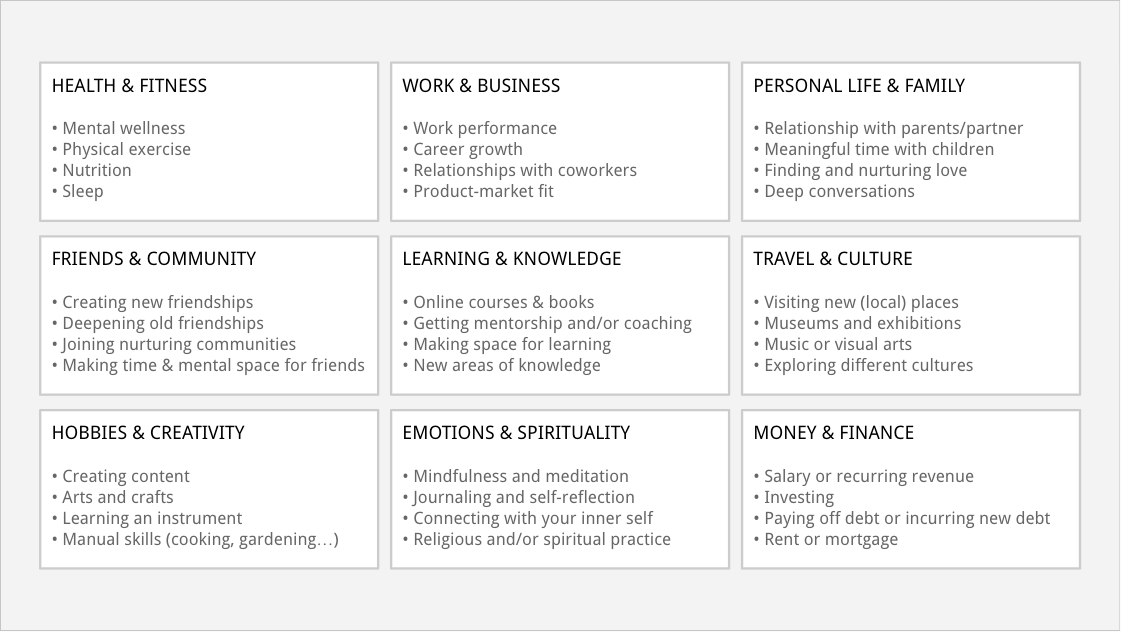
- Anne Laure's - Looove the simplicity and I think her 9 categories are spot on. But I found the reflection questions too simplistic (i.e. what went well, what didn't go so well, what will you focus on next year for each of the 9 categories) and not conducive to reflection and learning.
What I will be using
Schlaf’s - We’ve been using it every year since 2022.
Yes, it has a lot of questions. But unlike most templates, it’s operationalized well. It’s divided into eight clear steps and sets realistic expectations: 45–60 minutes at a time, for a total of ~8 hours, spread over 2–3 weeks.
Most importantly, the steps actually build on each other:
- data collection: collect data on moments & memories
- reflection: reflect on lessons & learnings; rate different areas of life
- focused goal setting: explore possibilities for goals & intentions; choose
Plus, I think the AI prompts are interesting and will help to extract insights and spot patterns.
I made one small tweak: I swapped his 12 life dimensions for Anne-Laure’s 9.
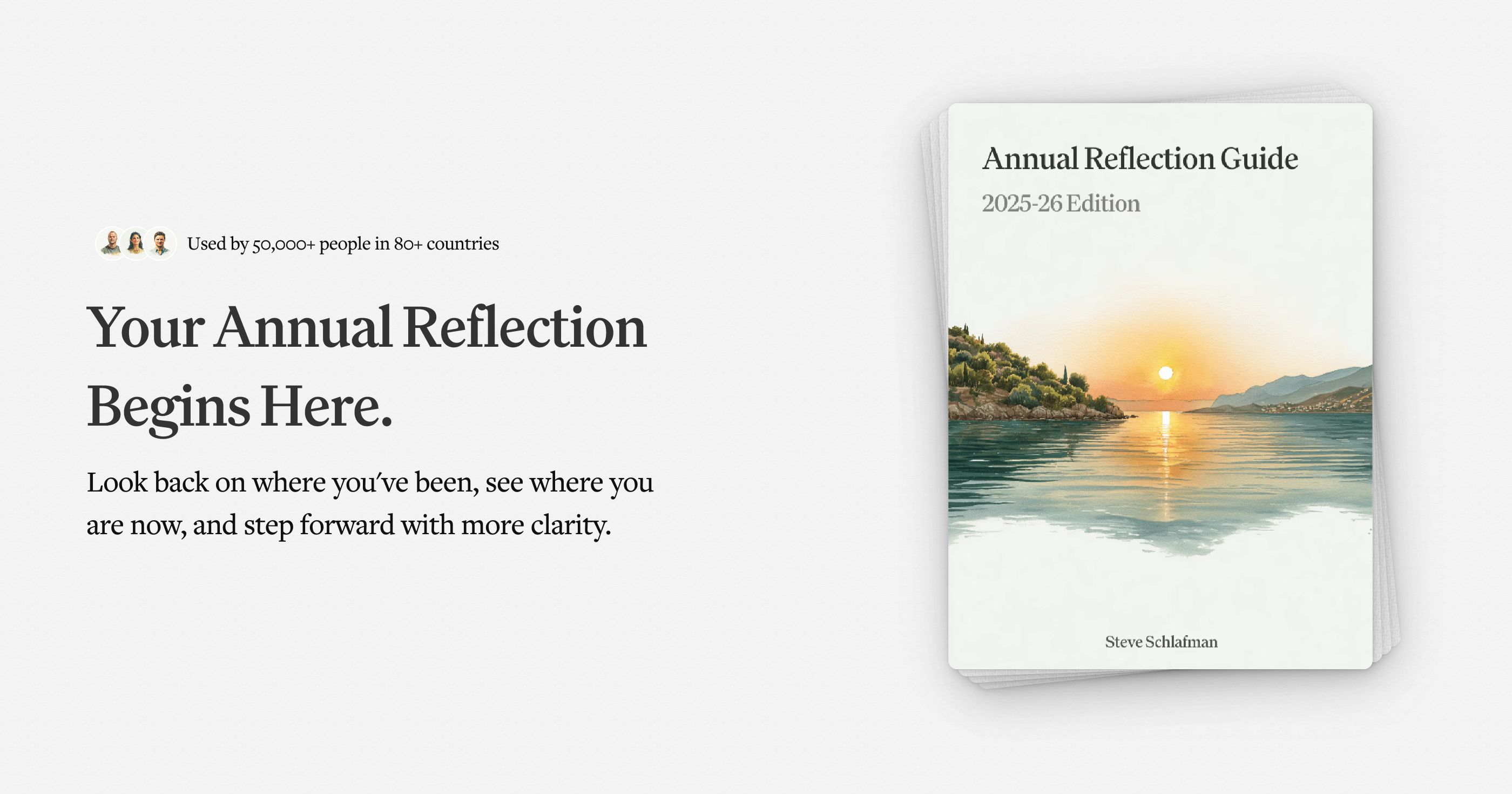
Here is his guide:
Annual Reflection Guide | Steve Schlafman
A guided experience to honor where you’ve been, take stock of where you are, and step into 2026 with intention. Get the free guide today.

Here is my slightly modified version:
[Chiara Template] 2025/2026 Annual Reflection
2025/26 Annual Reflection Guide Welcome Welcome to the 2025/26 Annual Reflection Guide. I’m so glad you’ve taken the time and space to reflect on your life. Each year I choose a theme for the guide, a lens to look through while reflecting. This year it’s relationality—the idea that everything is…