Is building a business supposed to consume your life - even when you do everything right?
I’ve been thinking about why work still consumes founders even when they prioritize well, automate, and build great systems. This post explores whether that pattern is inevitable.
I recently read an article (“Sacrifice your health for your startup”) by Jason Cohen where he makes a blunt claim:
Building a successful startup tends to consume all of your time and requires sacrificing your health and personal life... even if you’re productive, well-resourced, have a team, and prioritize well.
This is because of what he calls the “Rule of Time in Startups”:
How much time does a bootstrapped company take? All of it.
I find this conclusion very... interesting. The reason I love Jason's content is because he seems to deeply understand all the “best practices,” actually applies them to his own life, and then — when they still fall short — doesn’t stop at “well, you just have to find your own way.” He goes further and tries to articulate a path forward that feels workable and grounded. When he writes something, I take it seriously.
However, there are countless books and articles on productivity, prioritization, delegation, automation, systems, and balance. Technology has improved so much that we no longer need to procure and maintain servers, we can write emails instead of snail mail, and now we have ChatGPT…
Yet when you look at real founder case studies, many of them still end up living exactly the pattern Jason describes.
Why is that?
So instead of arguing about whether founders should work this way, I asked a different question:
What are the forces that push founders into this pattern so reliably? And is it possible to break the pattern — to build both a successful business and a successful life?
What causes work to consume your life?
Is it volume of work?
If the problem were just volume of work, we would expect better tools, delegation, or productivity systems to solve it. But many founders still feel overwhelmed even with teams, money, and experience. In fact, it often seems like overwhelm grows more rather than less.
Is it failing to prioritize?
There are always more things to do than time to do them. That’s a given. The obvious answer isn’t to find more time — it’s prioritization. But Jason is a maniac for prioritization. If prioritization were sufficient, he should be the counterexample. And yet, by his own account, the work still consumed his life.
Somewhere in thinking about that tension, I kept landing on the word complexity. I don’t have a clean logic for why, so this is less a proven conclusion and more a working hunch:
I suspect complexity is the main factor.
From there, I tried to model how complexity behaves inside a business.
Three forces behind why work takes over even when you do everything “right”
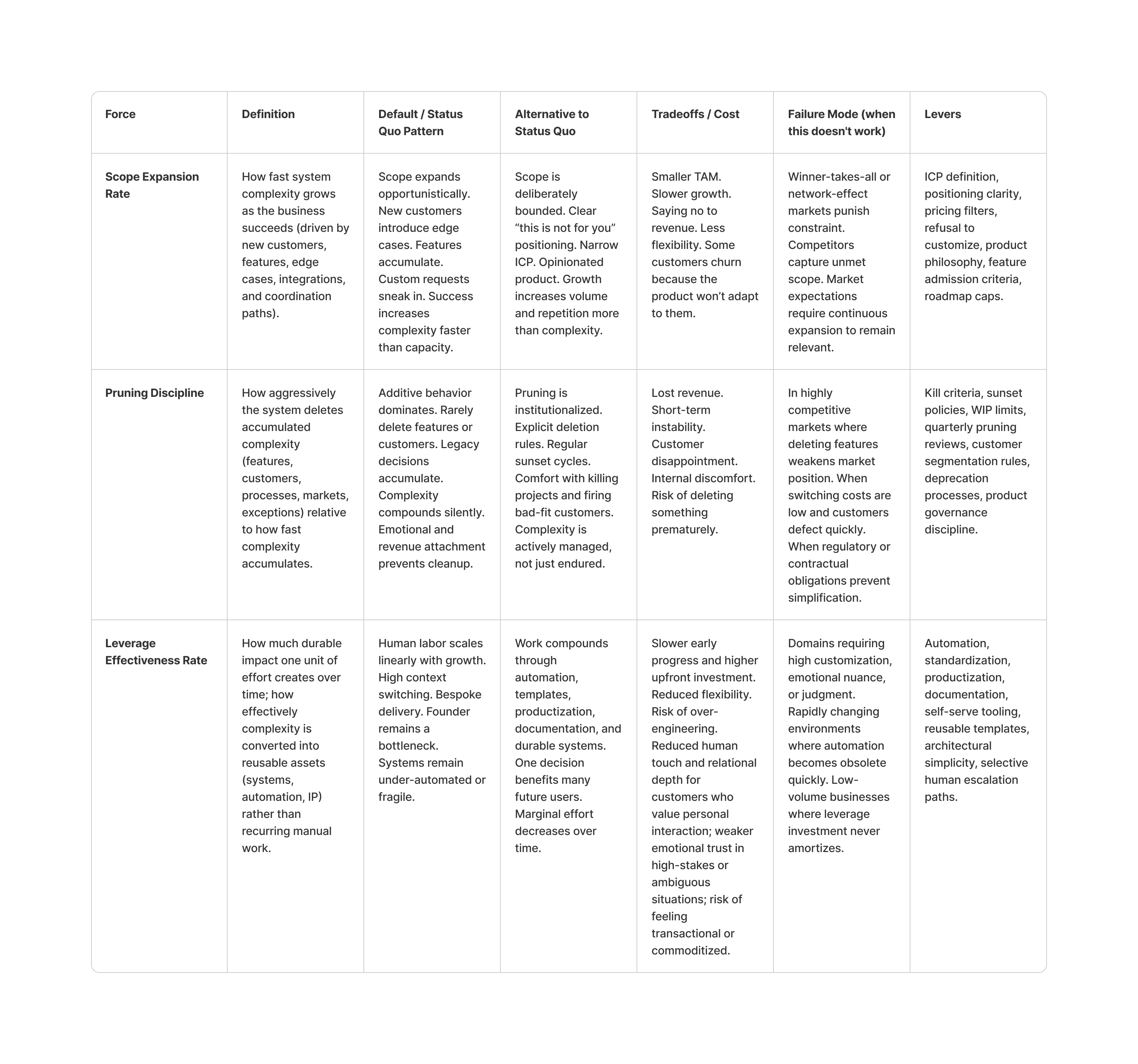
I ended up with a matrix that looks at three factors. All three are really about how complexity grows, gets reduced, or gets handled more efficiently as systems and leverage compound.
The three factors
- Scope Expansion Rate: How fast complexity in the business grows as it gains success (new customers, features, edge cases, integrations, coordination paths).
- Pruning Discipline: How aggressively the system deletes accumulated complexity (features, customers, processes, markets, exceptions).
- Leverage Effectiveness Rate: How fast the systems, automation, and assets built reduce the amount of complexity a human has to carry over time (or whether complexity continually grows faster than our ability to absorb it)
Market pressure exists as a separate layer that constrains what’s realistically possible. If you’re Uber, the VC funding model and winner-take-all dynamics force you to keep expanding scope. You can technically choose to limit it, but that is effectively choosing to fail.
The matrix focuses on the three internal dynamics.
Here is v1 of the matrix:
Can I build both a successful business and life – or am I just lazy?
I want to build both a successful business and a good life. Not as a lucky accident or something you get only after “making it,” but as something you can intentionally design toward.
I keep wondering whether that’s actually possible — not just in theory, but in real life. Whether you can shape a business that doesn’t inevitably consume everything as it grows.
Or whether I am just being naive. Or lazy. 😅
To pressure-test this model, I want to look at a few concrete cases:
- My previous employers
- Giant Swarm (enterprise managed Kubernetes platform; raised funding once; mostly profitable; founders very intentional about controlling their own density).
- Forto (VC-funded logistics unicorn based in Berlin).
- OnFrontiers (where we were relatively successful at having leverage grow faster than complexity).
- Founders who operated across different business models
- Nathan Barry: freelance designer -> creator business with books and courses → bootstrapped SaaS (Kit)
- Laura Roeder: social media consulting and online courses (LKR Social Media) → bootstrapped SaaS (MeetEdgar) → another bootstrapped SaaS (Paperbell)
What’s interesting to me is the same people operating under different structural conditions (freelancer, agency, creator business, bootstrapped SaaS).
From here, I want to do two things:
- Deepen the analysis
Apply the matrix more rigorously to real cases and see where it holds, where it breaks, and what’s missing.
- Operationalize this for myself
Design my business so complexity doesn’t inevitably consume everything as it grows — and make conscious choices about which levers to pull and which tradeoffs I’m willing to accept.
At this point, this is still exploratory, but I find the framing useful already:
If complexity grows faster than it can be pruned, and faster than leverage reduces the complexity a human has to carry over time, someone pays the price — often the founder.
If you have thoughts, ideas, or experiences — especially ones that confirm or disconfirm this — I’d looove to hear them. The best way is to write your own post in response, reach out on Bluesky, or email me at chiara@chiaracokieng.com
This whole thing came together on a Saturday morning between 9am and 1:30pm — with a lot of help from ChatGPT and sadly not enough coffee.