Letter to Zi: On Freelancing, Productized Services, and the Multiple Streams of Income Trap (My Recommendations for Starting a Business)
Here's everything I know about starting a business so far: the freelancer vs. business owner decision, the multiple streams of income trap, the three phases of building and the key skills for each. Beware of taking advice at the wrong phase.
Hi Zi,
You asked me for recommendations on building a business. It's not something I could cover in our call, so I wrote it all down instead.
Before anything else, read about the 1000 Day Rule: https://tropicalmba.com/articles/living-the-dream (If the link doesn't work, copy-paste the URL into your browser.)
The basic idea: for the first three years of starting your business, you're going to be poorer than when you were employed. Just knowing this helps manage expectations. When I started my first business in 2013, I genuinely thought I was going to 3x my income in three months.
Freelancer or Business Owner
Once you decide you're no longer going to be an employee, I think the choice is between two paths: freelancer or business owner. A freelancer trades time for money. A business owner builds something where time is disconnected from money — products, systems, and teams that can run without you.
Personally, I don't love freelancing. Like an employee, you're still trading time for money. Except now, instead of one boss, you have multiple bosses: your clients. And you have to keep finding new ones!
If you're going down the freelancing route anyway, some recommendations:
- Book Yourself Solid — for the business side
- The Trusted Advisor — for managing clients and getting them to actually implement your advice
What I prefer to start out with is "productized services."
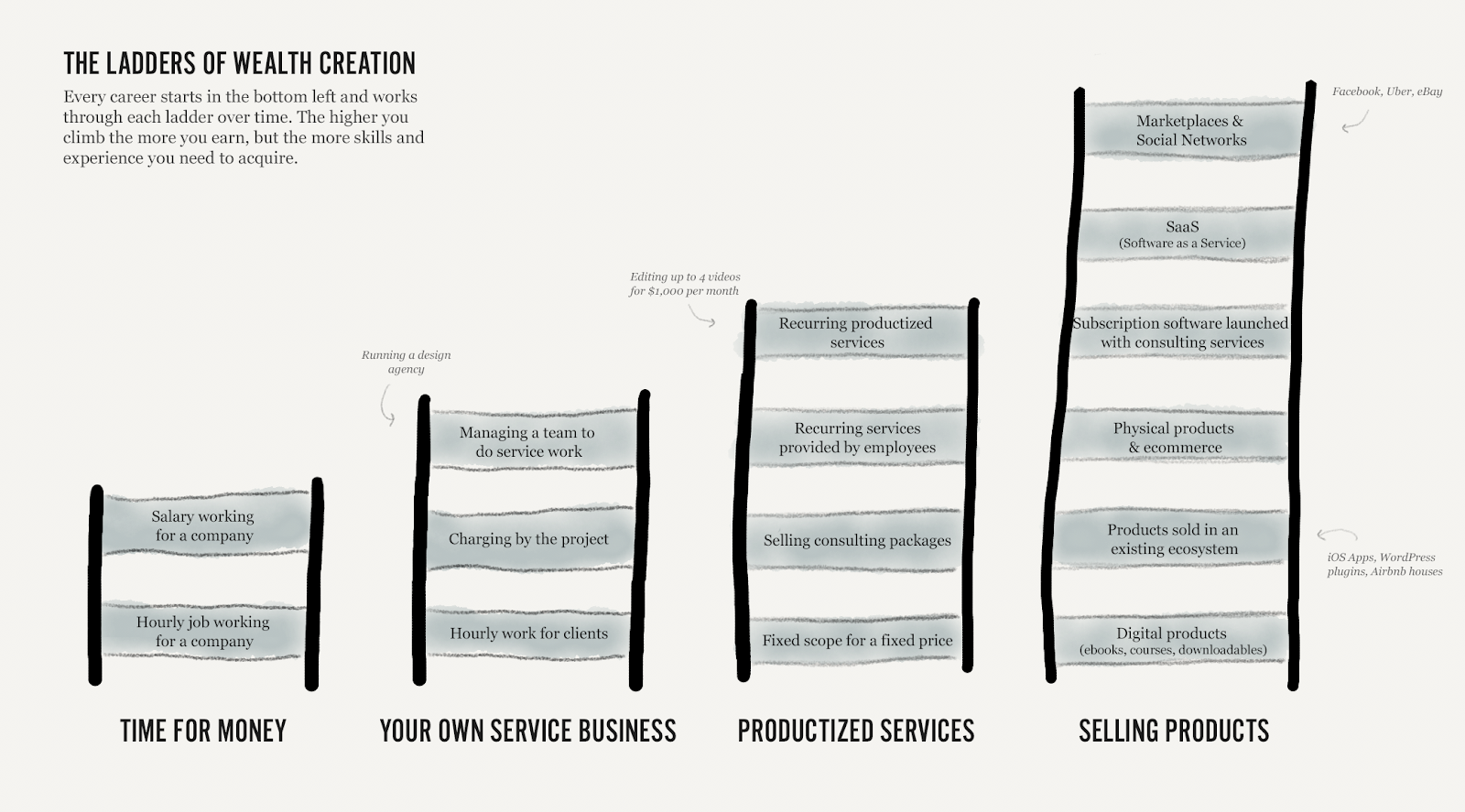
Recommendations:
- Blog post: Nathan Barry's Ladders of Wealth Creation
- Built to Sell – fictional business book about a marketing agency that did everything for everyone (logos, brochures, websites) and changed to a productized service (just logos). "Building to sell" doesn't necessarily mean actually selling, it means creating a business that can run without you, which turns out to be a less stressful and more profitable business – a better business – anyway.
Three types of businesses
Most people in tech only have the mental model for one: the VC-funded startup that wants to be a unicorn. But in my mind, there are really three types:
- VC-funded tech business
- Solopreneur / freelancer
- "Small giants" — small, profitable, intentional companies that don't optimize for growth and scale, by default and at all costs; companies that "choose to be great, instead of big"
The small giants path is the most appealing to me.
Some books I'd recommend:
The biggest trap: multiple streams of income
At the start of your building journey, a big trap to avoid is 'multiple streams of income'
I see a lot of solopreneurs not making enough money from their core offer, so they add more and more products and services, earning a few hundred euros here, a few hundred euros there.
But here's the thing — running a business already means doing five jobs:
- CEO / Strategy
- Sales & Marketing
- Product / Service
- Business Operations
- Finance
One stream of income is already five jobs. Two streams is ten. Five streams is twenty-five. This path leads to burnout and poverty, not wealth.
I believe: to build wealth, you need to focus. To multiply wealth, you diversify. This is standard financial advice, but I think it applies equally to business.
If you don't believe me, believe Warren Buffett:
"Diversification may preserve wealth, but concentration builds wealth."
My preferred approach: find one promising thing, iterate on it until it's working and scalable (to me that means €1M in annual revenue), then add new products.
Here's what Alex Hormozi says:
"Sell one product to one avatar on one channel... until you hit $1M per year in revenue."
The phases — Warning: avoid taking advice at the wrong phase
I'm only in Phase 2, so take everything below with that caveat.
Phase 1: Offer Creation, Marketing, Sales, and Consistency
This phase is very hard. It took me a year. It was the hardest year of my life.
The key skills:
- Creating offers — there's an important distinction between an offer (a concept you can sell) and a product (something you've built). When I started, I sold a one-page Google Doc outlining a program for €1,000, with weekly 1:1s for six months. No videos, no online course, just a Google Doc. That's an offer.
- Generating leads — there are many ways, but the fastest one most people resist is direct outreach.
- Closing sales
First you learn to do each of these. Then you learn to do them consistently, i.e. build a reliable sales and marketing machine, so you can escape feast and famine.
Recommendations:
- The Lean Startup and Running Lean – for the concept of tackling the riskiest part of your business first, and selling an offer before you even have a product
- $100M Offers – step by step on creating offers
- $100M Leads – step by step on generating leads
Phase 2: Client Success and Operational Consistency
This is where I am now.
The key skills:
- Building the actual product or service
- Client delivery and success
- Operations: KPIs, finances, systems and processes, hiring and training
This is where product management, client success, team building, and books like Traction and Scaling Up start to apply.
Phase 3: Scaling
I'll update you when I get here.
What I'll say for now: there is so much scaling advice targeted at people who are nowhere near ready for it. It's genuinely dangerous. Avoid until you're solidly past Phase 2.